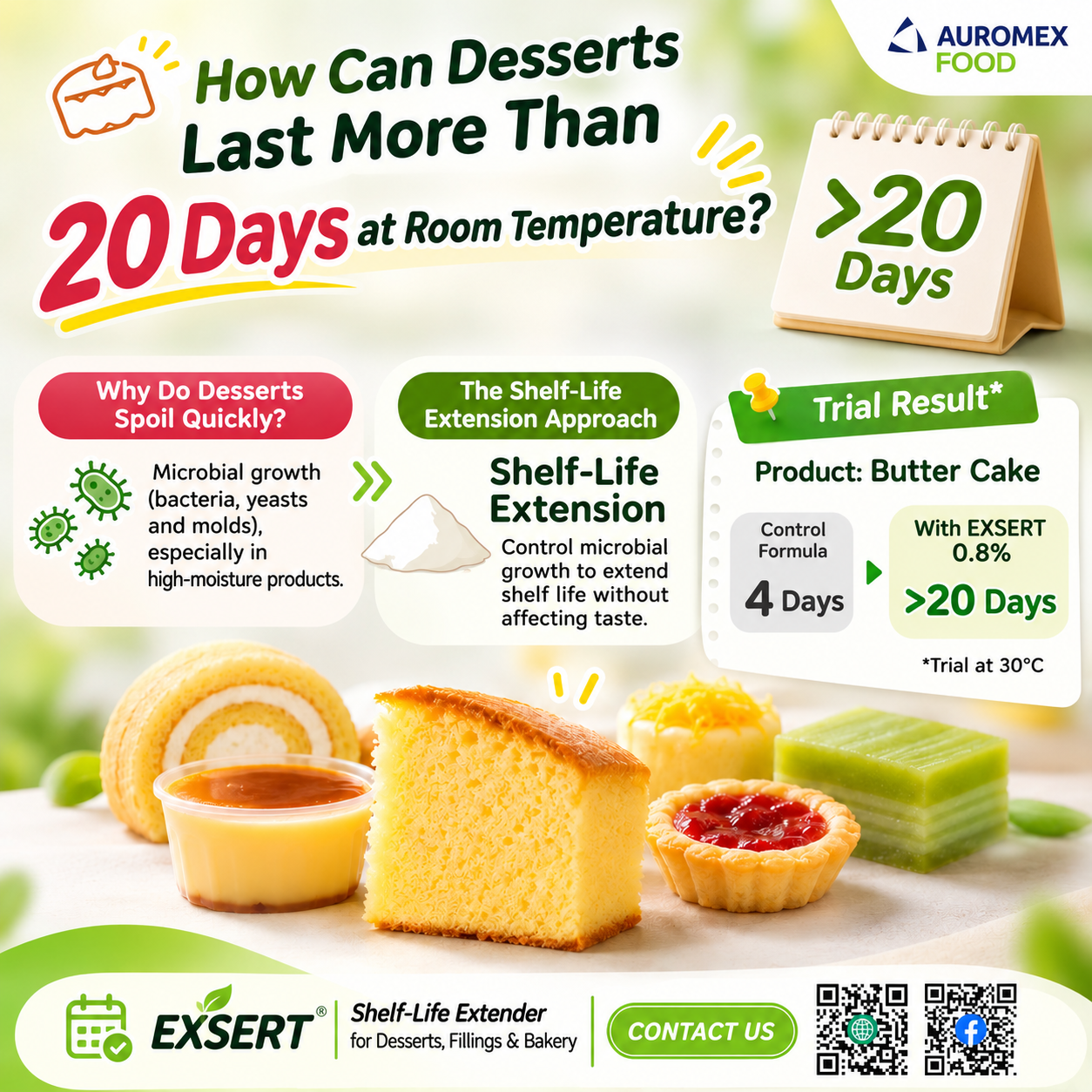
How Can Desserts Last More Than 20 Days at Room Temperature?
Exploring Shelf-Life Extension Technology for Desserts, Fillings, and Bakery Products Without Compromising Taste and Quality
Have you ever wondered why some desserts spoil within just 2–3 days, while others can maintain their quality for much longer, even at room temperature?
For manufacturers of desserts, fillings, and bakery products, shelf life is a critical factor influencing product quality, production costs, distribution, and market opportunities.
Products with a short shelf life may face limitations in transportation, retail distribution, and inventory management. Extending shelf life can help manufacturers reduce product losses and expand their distribution capabilities. However, extending dessert shelf life is not simply about adding preservatives. It begins with understanding the causes of food spoilage and selecting the right preservation technologies.
Why Do Desserts, Fillings, and Bakery Products Spoil Quickly?
Microbial growth is one of the major causes of spoilage in desserts and bakery products. Bacteria, yeasts, and molds can cause undesirable changes in appearance, aroma, taste, texture, and overall product quality.
Several factors influence microbial growth and product shelf life.
- Moisture and Water Activity (aw) Water availability plays an important role in microbial growth. Products with high water activity may provide favorable conditions for certain microorganisms, particularly desserts containing cream, custard, milk, or coconut milk. It is important to distinguish between moisture content and water activity. While moisture content represents the total amount of water in a product, water activity indicates how much water is available for microbial growth and other reactions.
- Acidity and pH The pH of a food product influences the ability of microorganisms to grow. Different microorganisms have different pH requirements. Controlling pH can therefore help limit the growth of certain microorganisms and contribute to improved shelf-life stability.
- Storage Temperature Temperature directly affects microbial growth rates. Products intended for room-temperature storage require careful consideration of their formulation, processing conditions, packaging, and microbiological safety.
- Manufacturing Processes and Packaging Good manufacturing hygiene, appropriate heat treatment, prevention of post-processing contamination, and suitable packaging all play important roles in maintaining product quality. Effective shelf-life management requires manufacturers to consider these factors together rather than relying on a single preservation method.
What Is Shelf-Life Extension Technology?
Shelf-Life Extension refers to technologies and strategies designed to delay food deterioration while maintaining acceptable quality and safety throughout a product’s intended storage period.
Shelf-life extension may involve several approaches, including:
- Controlling water activity and moisture availability
- Adjusting pH and acidity
- Applying appropriate thermal processing
- Improving manufacturing hygiene
- Selecting suitable packaging systems
- Using ingredients that help inhibit microbial growth
One promising approach involves combining ingredients that work together to interfere with essential microbial cell functions.
How Does Shelf-Life Extension Technology Inhibit Microbial Growth?
Certain antimicrobial ingredients can interfere with the structure and function of microbial cell membranes. The cell membrane plays an essential role in regulating the movement of substances into and out of microbial cells.
When membrane integrity or permeability is disrupted, microorganisms may lose their ability to maintain normal cellular functions. Some compounds can also affect intracellular pH balance and interfere with the energy-generating processes required for microbial survival and growth.
As a result, microbial growth may be inhibited, helping delay microbial spoilage and extend product shelf life. However, the effectiveness of these mechanisms depends on the food formulation, microbial species, processing conditions, and storage environment.
EXSERT: A Shelf-Life Extension Solution for Desserts, Fillings, and Bakery Products
Auromex Food offers EXSERT – Shelf-Life Extender for Desserts, Fillings & Bakery, a solution developed to help inhibit microbial growth and extend the shelf life of food products.
EXSERT contains a synergistic combination of Glycine and Sodium Acetate.
According to the product’s technical information, this combination helps inhibit microbial growth through mechanisms involving microbial membrane disruption and intracellular acidification. These effects can interfere with microbial cellular processes, contributing to delayed microbial growth and spoilage. EXSERT is formulated to support shelf-life extension without adversely affecting product taste. It is designed for applications in desserts, fillings, and bakery products.
The product leaflet indicates a general addition level of 0.5–1.5% of total product weight, depending on the application. The appropriate dosage should be determined through formulation-specific trials and verified against applicable food regulations.
Product Trial: Extending Butter Cake Shelf Life from 4 Days to More Than 20 Days
One example demonstrating the potential of EXSERT is a butter cake storage trial conducted at 30°C.
The trial compared a control formulation with a formulation containing 0.8% EXSERT.
|
Parameter |
Trial Result |
|
Product |
Butter Cake |
|
EXSERT Addition Level |
0.8% |
|
Storage Temperature |
30°C |
|
Control Shelf Life |
4 days |
|
Shelf Life with EXSERT |
More than 20 days |
|
Total Plate Count (TPC) |
Below 10 CFU/g, as reported in the trial |
The results demonstrate the potential of EXSERT to help control microbial growth and extend the shelf life of butter cake under the tested conditions.
Additional Applications: Custard Cream and Coconut Milk
The EXSERT product leaflet also reports trials involving other dessert applications.
Custard Cream
With 1.0% EXSERT added and storage at 25°C, the reported shelf life increased from 2 days to 4 days.
Coconut Milk for Desserts
With 1.0% EXSERT added and storage at 10°C, the reported shelf life increased from 7 days to more than 15 days. These examples demonstrate that shelf-life extension performance varies depending on the product formulation and storage conditions. The results should not be interpreted as a guarantee that every dessert can be stored at room temperature for more than 20 days.
How Can Manufacturers Extend Shelf Life Without Compromising Product Quality?
Shelf-life extension should not focus only on increasing the number of storage days.
Manufacturers should also consider the following aspects of product quality.
- Microbiological Safety Relevant spoilage microorganisms and foodborne pathogens must be evaluated according to the risks associated with each product.
- Taste and Aroma Flavor characteristics should remain acceptable throughout the intended shelf life.
- Texture and Appearance Changes in softness, moisture retention, structure, color, and appearance should be monitored during storage.
- Manufacturing Consistency Consistent formulation, processing conditions, and hygienic practices are essential for reliable shelf-life performance.
- Packaging and Storage Conditions Packaging materials and storage requirements should be selected according to the characteristics and safety requirements of each product.
A product-specific Shelf-Life Study should be conducted to establish the appropriate storage period based on microbiological, physicochemical, and sensory evaluations.
Frequently Asked Questions (FAQ)
- Can desserts really last more than 20 days at room temperature?
Yes, certain dessert formulations may achieve extended shelf life when properly developed and validated. For example, a butter cake trial using 0.8% EXSERT demonstrated an increase in shelf life from 4 days to more than 20 days at 30°C. However, actual shelf life depends on the product formulation, manufacturing process, packaging, and storage conditions. These results cannot be generalized to all dessert products.
- Why do high-moisture desserts spoil quickly?
High-moisture desserts often contain water that is available for microbial growth. Products with high water activity may support the growth of bacteria, yeasts, or molds, depending on their formulation, pH, and storage conditions. Controlling water activity and other factors can help reduce the risk of microbial spoilage.
- What is EXSERT, and how does it extend dessert shelf life?
EXSERT is a shelf-life extender developed for desserts, fillings, and bakery products. It contains Glycine and Sodium Acetate, which work together to inhibit microbial growth through mechanisms involving microbial membrane disruption and intracellular acidification. These effects help delay microbial spoilage and support shelf-life extension.
- What types of desserts can EXSERT be used in?
EXSERT is designed for applications in desserts, fillings, and bakery products. The product leaflet includes trial results for Butter Cake, Custard Cream, and Coconut Milk for Desserts. Manufacturers should evaluate its suitability for each formulation and verify compliance with applicable food regulations.
- Does EXSERT affect the taste of desserts?
According to the product information, EXSERT is designed to extend shelf life without adversely affecting product taste. However, sensory performance may vary depending on the formulation and addition level. Product-specific sensory evaluation is recommended before commercial application.
- What is the recommended dosage of EXSERT?
The product leaflet indicates an addition level of 0.5–1.5% of total product weight, depending on the application. For example, the butter cake trial used 0.8% EXSERT. Manufacturers should consult the Auromex Food technical team to determine an appropriate addition level and verify regulatory requirements.
- Can EXSERT replace traditional preservatives?
EXSERT provides antimicrobial functionality that may support shelf-life extension. Whether it can replace another preservative depends on the food formulation, required antimicrobial performance, and applicable regulations. Using EXSERT does not automatically justify a “preservative-free” claim.
- Can desserts containing EXSERT be stored without refrigeration?
Not necessarily. Storage requirements depend on the product’s formulation, microbial risks, processing conditions, and validated shelf life. EXSERT should not be considered a universal replacement for refrigeration, especially for products that require temperature control for food safety.
- How can manufacturers determine the shelf life of their dessert products?
Manufacturers should conduct product-specific shelf-life studies under representative storage conditions. Testing should include relevant microbiological parameters, physicochemical characteristics, and sensory quality. Where appropriate, foodborne pathogens must also be evaluated based on product-specific risk assessments. Total Plate Count alone is not sufficient to establish food safety throughout the intended shelf life.
Conclusion: Extending Dessert Shelf Life Through Food Science
Extending the shelf life of desserts, fillings, and bakery products begins with understanding the causes of food spoilage and selecting appropriate technologies.
By combining food science, microbial control, formulation development, hygienic processing, and suitable packaging, manufacturers can develop products with improved shelf-life performance while maintaining desirable quality characteristics.
EXSERT from Auromex Food offers an additional approach to shelf-life optimization through its synergistic combination of Glycine and Sodium Acetate.
Its reported product trials demonstrate the potential to delay microbial growth and extend shelf life under specific storage conditions.
Because effective shelf-life extension is not simply about keeping food longer — it is about maintaining the quality, safety, and taste consumers expect.
Disclaimer: Trial results are based on the EXSERT Product Leaflet provided by Auromex Food. Actual performance may vary depending on formulation, processing, packaging, and storage conditions. Product-specific shelf-life validation, food safety testing, and regulatory compliance assessments are recommended before commercial application.