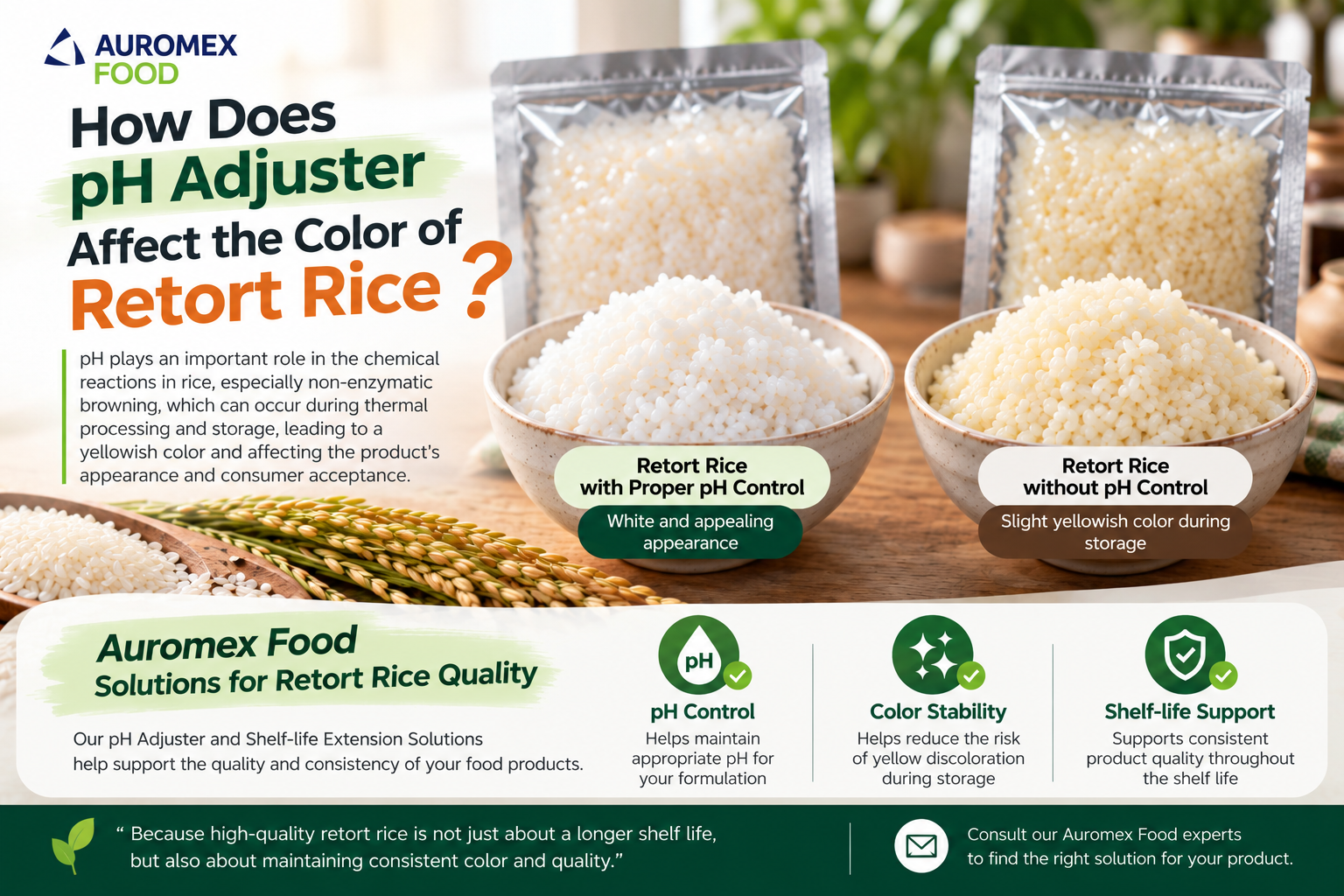
Why Does Retort Rice Turn Yellow During Storage? The Role of pH Adjusters in Color Stability
Retort rice is a widely used ready-to-eat (RTE) food product valued for its convenience, extended shelf life, and ability to be stored at ambient temperatures.
However, one of the quality challenges manufacturers may encounter is rice yellowing during thermal processing and storage. Over time, white rice may develop a slightly yellowish or cream-colored appearance, potentially affecting its visual appeal and consumer acceptance.
Understanding the factors contributing to rice discoloration, particularly the role of pH, is essential for improving product quality and maintaining color consistency.
What Is Retort Rice?
Retort rice is a ready-to-eat rice product that undergoes thermal sterilization in hermetically sealed, heat-resistant packaging.
The retort process uses controlled heat and pressure to achieve commercial sterility, allowing properly processed products to remain shelf-stable without refrigeration.
Retort technology is commonly used for ready-to-eat rice, seasoned rice, and rice-based convenience meals.
Although the process provides microbiological stability, exposure to high temperatures may also cause changes in food quality, including color, flavor, and texture.
Why Does Retort Rice Turn Yellow?
Rice yellowing may result from several interacting factors.
- Non-Enzymatic Browning Reactions Non-enzymatic browning is one of the chemical mechanisms associated with food discoloration. The Maillard reaction, which involves reducing sugars and amino compounds, can produce colored substances ranging from pale yellow to brown. Depending on the product formulation and processing conditions, these reactions may contribute to rice discoloration during thermal treatment and subsequent storage.
- Thermal Processing Conditions Retort sterilization involves elevated temperatures to ensure microbiological safety. Excessive thermal exposure may accelerate chemical reactions that affect rice color, flavor, and texture. Processing conditions must therefore balance food safety requirements with product quality.
- Storage Temperature and Duration Storage conditions can influence the rate of quality deterioration. Extended storage periods, particularly at elevated temperatures, may contribute to gradual discoloration and changes in sensory properties.
- Product Composition and pH Rice variety, moisture content, chemical composition, and pH can all influence color stability. These factors interact with processing and storage conditions, making formulation optimization an important part of retort rice development.
How Does pH Affect Retort Rice Color?
pH is an important factor influencing chemical reactions in food, including the Maillard reaction.
In general, Maillard browning tends to proceed more rapidly under relatively alkaline conditions, although the relationship depends on the food system.
Adjusting pH within a suitable range may help slow certain browning reactions and reduce the risk of yellow discoloration.
However, pH optimization must also consider product flavor, texture, ingredient compatibility, and microbiological safety. Lowering pH does not automatically guarantee better color stability in every rice formulation.
What Is a pH Adjuster?
A pH adjuster is a food ingredient or ingredient system used to modify or control the acidity or alkalinity of a food product.
In retort rice applications, a properly selected pH adjuster may support:
- pH Control: Maintaining an appropriate pH range for the formulation.
- Color Stability: Helping minimize chemical reactions associated with yellow discoloration.
- Quality Consistency: Supporting more consistent product characteristics during storage.
- Shelf-life Quality Support: Helping maintain selected quality attributes throughout the validated storage period.
The effectiveness of a pH adjuster depends on its composition, dosage, product formulation, and processing conditions.
Color Stability vs. Shelf-life Extension
Color stability and shelf-life extension are closely related but distinct quality objectives. Color stability refers to maintaining the desired appearance of rice throughout storage.
Shelf-life extension involves maintaining acceptable product quality and microbiological safety over a defined period.
For shelf-stable retort rice, validated thermal processing, packaging integrity, and appropriate formulation remain essential for product safety.
A pH adjuster should not be considered a substitute for a properly validated sterilization process.
Auromex Food: Solutions for Retort Rice Quality
At Auromex Food, we provide food ingredient solutions designed to support manufacturers in developing high-quality processed food products.
Our pH Adjuster and Shelf-life Extension Solutions focus on supporting formulation optimization, color stability, and consistent product quality.
For retort rice manufacturers, appropriate pH management may help reduce the risk of yellow discoloration while maintaining desirable product characteristics.
Product-specific testing is recommended to determine the most suitable formulation and verify performance under actual manufacturing and storage conditions.
Because high-quality retort rice is not only about a longer shelf life — it is also about maintaining consistent color, appearance, and overall product quality.
Frequently Asked Questions (FAQ)
Q1: Why does retort rice turn yellow during storage?
Rice yellowing may be associated with non-enzymatic browning reactions, thermal processing conditions, pH, ingredient composition, and storage temperature.
Q2: Can pH adjusters prevent retort rice yellowing?
Appropriate pH adjustment may help reduce certain browning reactions. However, performance depends on the formulation and must be confirmed through product-specific testing.
Q3: Does retort rice require preservatives?
Not necessarily. A properly designed and validated retort sterilization process can produce shelf-stable food without requiring chemical preservatives in every formulation.
Q4: Can pH adjusters extend the shelf life of retort rice?
pH adjusters may support the stability of selected quality attributes. Any claim of extended shelf life should be supported by appropriate quality and microbiological validation.
Q5: How can manufacturers evaluate rice color stability?
Manufacturers can use instrumental color measurements, such as CIELAB L*, a*, and b* values, alongside pH monitoring, sensory evaluation, and storage stability studies.