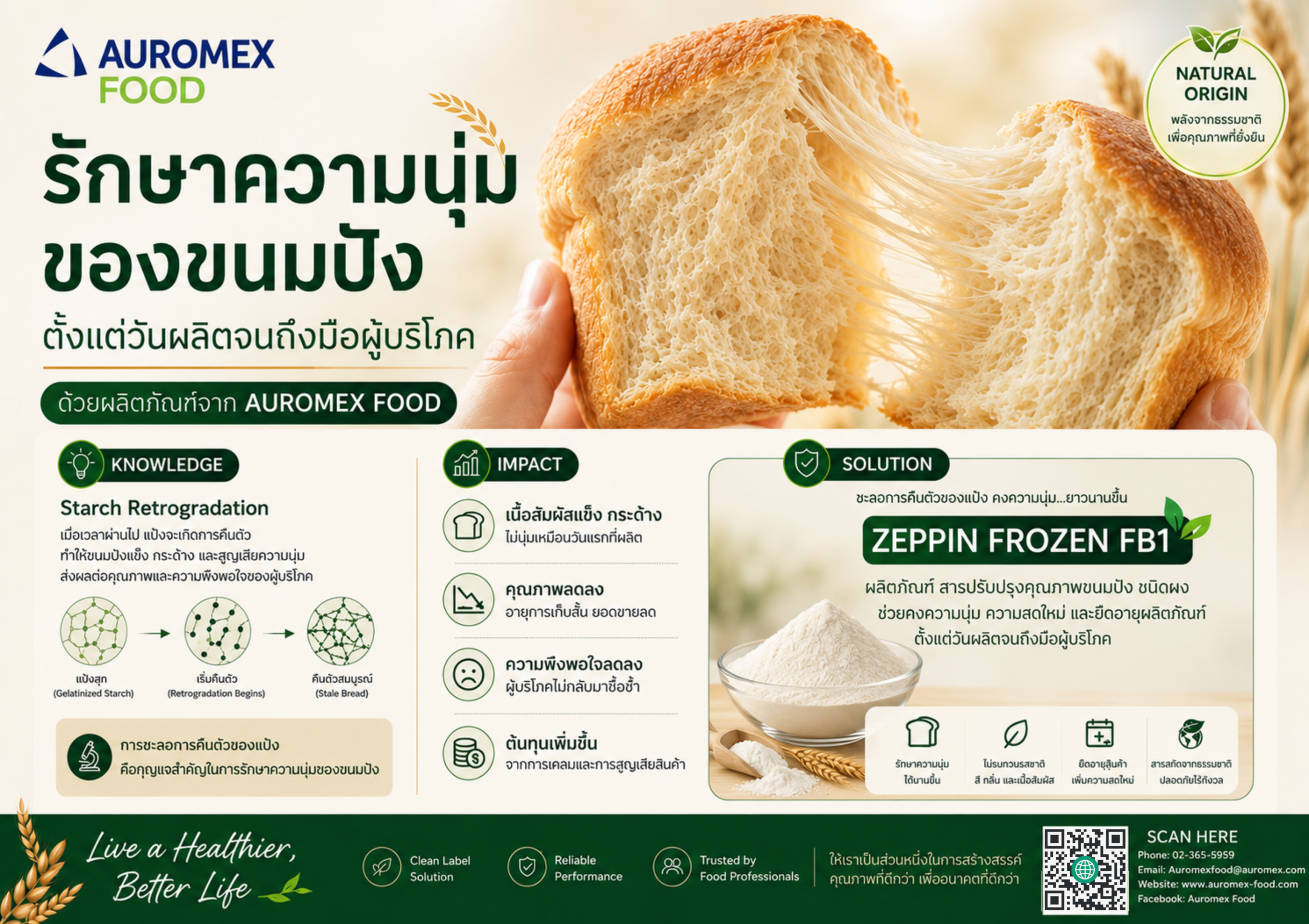
How to Maintain Bread Softness from Production to the Consumer
Freshly baked bread is soft, aromatic, and pleasantly fluffy.
However, after only a few days of storage, the crumb may become firmer, less elastic, and less enjoyable to eat—even when the product has not yet reached its expiration date.
This is a common challenge for bakery manufacturers, particularly for products that must undergo storage, transportation, or frozen dough processing before reaching consumers.
One of the key mechanisms behind this change is known as starch retrogradation.
What Is Starch Retrogradation?
During baking, starch granules absorb water and undergo structural changes under heat, contributing to the soft texture of freshly baked bread.
As the bread cools and is stored, starch molecules gradually reorganize into a more ordered structure.
This process is called starch retrogradation.
Over time, it can contribute to:
Increased crumb firmness
Reduced softness and elasticity
Moisture redistribution within the bread
A less fresh eating experience
Reduced overall product quality
For this reason, bread firming is not simply the result of “drying out.” Structural changes within the starch system also play an important role.
How Bread Firming Affects Bakery Manufacturers
When bread loses softness earlier than expected, it may create several commercial and quality challenges.
These can include:
Bread becoming firm before the intended selling period
Quality deterioration during distribution
Lower consumer perception of freshness
Reduced product satisfaction
Increased product waste or inventory losses
For bakery manufacturers, maintaining consistent texture throughout distribution is therefore an important part of product quality management.
How to Maintain Bread Softness
Maintaining bread softness requires a combination of formulation, processing, packaging, and storage control.
Key factors include:
Flour type and functionality
Dough hydration
Mixing conditions
Fermentation time and temperature
Baking conditions
Cooling process
Packaging
Storage conditions
Selection of an appropriate bread improver
A bread improver designed for the specific application can support dough structure, softness, volume, and finished-product consistency.
ZEPPIN FROZEN FB1 for Frozen Dough and Bakery Applications
ZEPPIN FROZEN FB1 is a bread improver designed for bakery and frozen dough applications.
It supports dough and finished-product quality, particularly in systems where dough must be frozen and stored before baking.
Key Benefits of ZEPPIN FROZEN FB1
- Helps Maintain Bread Softness ZEPPIN FROZEN FB1 helps support a soft and pleasant crumb texture after baking and during storage. This can help improve the overall eating experience throughout the intended product life.
- Supports Bread Volume and Oven Spring Bread volume and oven spring are important quality attributes in bakery products. ZEPPIN FROZEN FB1 supports dough structure and helps maintain the desired rise and appearance during baking.
- Suitable for Frozen Dough Systems The product is suitable for frozen dough applications where dough undergoes controlled fermentation and freezing as part of the production process.
- Supports Quality During Frozen Storage Freezing and thawing can affect dough structure and yeast performance. An improver designed for frozen dough can help support dough quality during storage and improve consistency after baking.
Suitable for a Wide Range of Bread Products
ZEPPIN FROZEN FB1 can be considered for applications including:
Sandwich bread
Bread rolls
Sweet bread
Filled bread
Frozen dough products
Bakery products requiring improved softness and volume
What Are the Challenges of Frozen Dough?
Frozen dough offers manufacturers flexibility in production, storage, and distribution.
However, freezing can also affect the structure of the dough.
During freezing and thawing, changes may occur in:
Gluten structure
Yeast viability
Dough elasticity
Gas retention
Bread volume
Crumb softness
If formulation and processing conditions are not properly controlled, these changes may reduce final product quality.
For this reason, frozen dough development should consider the complete system, including formulation, fermentation, freezing conditions, storage, thawing, proofing, and baking.
From “Soft When Baked” to “Soft When Delivered”
For bakery manufacturers, product quality does not end when bread leaves the oven.
The real challenge is maintaining softness, volume, and texture throughout storage, distribution, and sale.
Using an appropriate bread improver together with a well-controlled production process can help support more consistent product quality from production to consumption.
Develop Your Bakery Products with AUROMEX FOOD
If you are developing frozen dough products or looking for a solution to support bread softness, volume, and post-baking quality, AUROMEX FOOD is ready to support your product development.
Our team provides technical consultation, product trials, and formulation support based on your raw materials, production process, freezing system, and desired product characteristics.