How Acidity Regulators Can Support Ready-to-Eat Food Shelf Life
On rainy days or when shopping is inconvenient, having ready-to-eat food at home can make mealtimes easier. Behind that convenience is a product development process designed to maintain quality throughout storage and distribution.
For food manufacturers, shelf life depends on the formulation, production process, packaging and storage conditions. Acidity regulators are one of the tools that can help control product properties and support shelf life in suitable applications.
Why Do Some Ready-to-Eat Foods Last Longer?
Different ready-to-eat foods use different preservation approaches. Some require refrigeration or freezing, while others can be stored at room temperature after appropriate processing and packaging.
Their shelf life does not depend on a single ingredient. It results from a combination of measures, which may include heat treatment, pH control, protection against contamination and specified storage conditions.
Ready-to-eat describes a food’s readiness for consumption. It does not mean that every product in this category is shelf-stable.
What Are Acidity Regulators?
Acidity regulators are food additives used to adjust or control a product’s acidity or alkalinity. Their selection should reflect the formulation and the intended development objective.
In foods suited to acidity control, adjusting pH may help create conditions that limit the growth of certain microorganisms. This can contribute to a broader shelf-life strategy.
However, acidity regulators are not interchangeable with every type of preservative, and they do not guarantee longer shelf life in every food. Performance depends on the selected ingredient, dosage, final product pH and other control measures.
Matching pH Control to the Product
Formulation development requires a balance between functionality and the qualities consumers expect. Changes in acidity can affect flavour and other product characteristics.
Manufacturers should consider:
- Formulation: Ingredients and food composition influence how the product responds to acidity adjustment.
- Target quality: Evaluate aroma, flavour, colour and texture after reformulation.
- Processing: Consider mixing, heat treatment and filling conditions.
- Storage requirements: Align the product with its intended transportation and sales channels.
- Shelf-life testing: Verify quality and safety under the defined storage conditions.
pH control should therefore form part of the product development system rather than replace appropriate processing and hygiene controls.
Shelf-Life and Acidity Control Solutions from AUROMEX FOOD
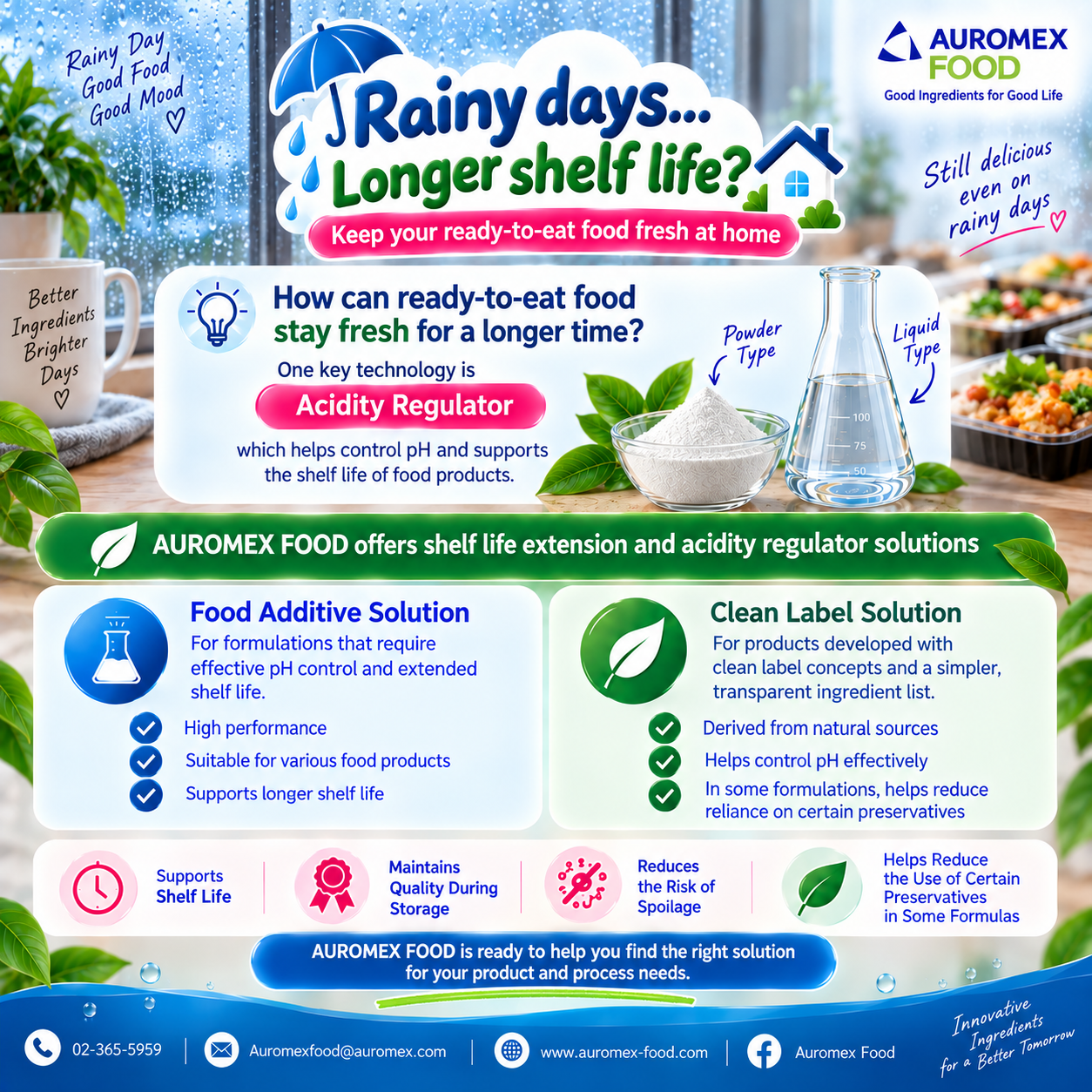
AUROMEX FOOD supplies ingredient solutions for food manufacturers, supporting shelf-life development and quality maintenance in ready-to-eat products.
Available approaches include Food Additive Solutions and Clean Label Solutions.
Food Additive Solutions
Options for manufacturers seeking food additives that match the required formulation function, quality targets and production process. Ingredient selection and usage levels should comply with the applicable requirements.
Clean Label Solutions
Options for manufacturers working towards specific ingredient-list and labelling objectives. Selection should reflect the brand’s criteria and target market.
Clean label does not automatically mean additive-free or preservative-free. Ingredient details and label claims should be assessed for each product.
Supporting Shelf Life While Maintaining Food Quality
When appropriately selected and validated, ingredient solutions may support development goals such as:
- Achieving the intended storage life.
- Maintaining quality during storage.
- Reducing the specific spoilage risks addressed by the solution.
- Reducing reliance on certain preservatives in some formulations, where testing supports the change.
Results may differ between applications. Any replacement or reduction of existing ingredients should be evaluated for functionality, sensory quality and safety before commercial implementation.
Frequently Asked Questions
Can acidity regulators extend the shelf life of every food?
No. The product must be suitable for pH adjustment, and its effects on quality and microbial control need to be evaluated in the actual formulation.
Does adding an acidity regulator remove the need for refrigeration?
No. Storage requirements depend on the formulation, processing, packaging and validation results. Adding an acidity regulator alone does not establish that a product can be stored at room temperature.
Does clean label mean preservative-free?
Not necessarily. Ingredient composition, function and the target market’s labelling requirements should be reviewed before making a claim.
Choose a Shelf-Life Solution That Fits Your Product
Whether developing a standard formulation or working towards clean label objectives, ingredient selection should begin with the product’s needs and actual distribution conditions.
AUROMEX FOOD can help select shelf-life and acidity control solutions suited to your formulation, production process and target storage life.