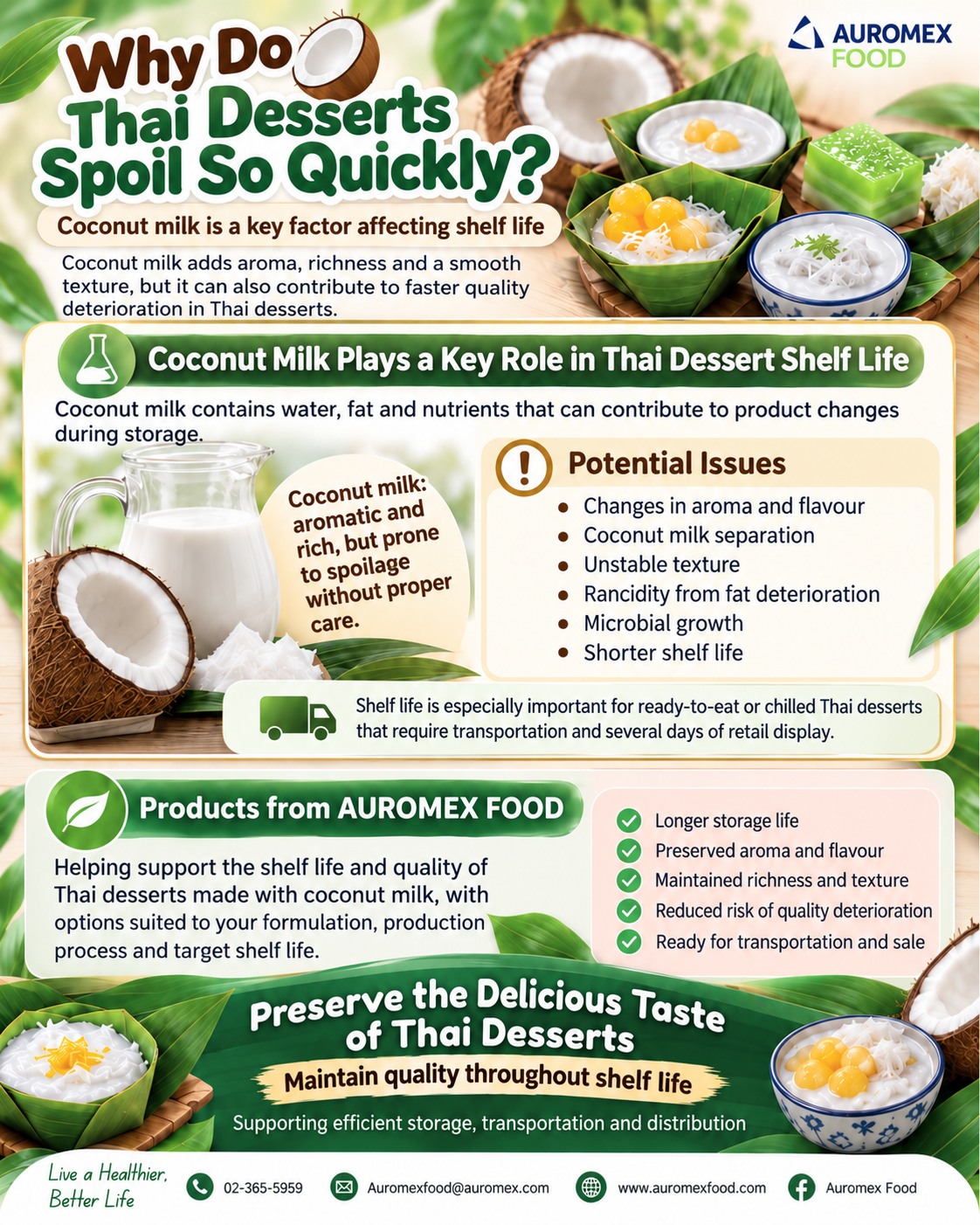
Why Do Thai Desserts Spoil Quickly? Understanding Coconut Milk Dessert Shelf Life
Coconut milk gives many Thai desserts their distinctive aroma, richness and smooth texture. From khanom thuai and tako to bua loi and khanom chan, it is central to the eating experience consumers enjoy.
For food manufacturers and dessert businesses, however, quality on the day of production is only part of the challenge. Products must also maintain acceptable characteristics throughout their intended storage and distribution period.
Understanding Thai dessert shelf life starts with the whole product: its ingredients, formulation, processing, packaging and storage conditions. Coconut milk is an important consideration, but it is not the only factor that determines how quickly a dessert deteriorates.
How Does Coconut Milk Affect Thai Dessert Shelf Life?
Coconut milk contains water, fat and nutrients. When combined with starch, sugar, eggs or other ingredients, it becomes part of a food system whose properties depend on the complete recipe.
For microbial growth, total moisture alone does not tell the whole story. Water activity, or aw, describes the availability of water for microorganisms. Higher available moisture can support growth when other conditions are suitable. Learn more from the FDA guide to Water Activity in Foods.
This is why shelf life must be assessed for the finished dessert rather than inferred simply from the presence of coconut milk.
Common Quality Challenges in Coconut Milk Desserts
Several types of deterioration may affect coconut milk desserts during storage:
-
Changes in aroma and flavour: The characteristic aroma may fade, or unwanted notes may develop.
-
Separation: Fat and water phases may separate, affecting appearance and consistency.
-
Texture changes: Depending on the formulation and storage conditions, desserts may become firmer, thinner or release water.
-
Rancidity: Changes in fats may produce undesirable odours and flavours.
-
Microbial growth: Inadequate control can lead to spoilage or food safety concerns.
These changes can shorten the period during which the product remains acceptable. They do not necessarily occur together, and the first limiting factor may differ between desserts.
Coconut milk is an emulsion, and heat treatment can affect its properties and stability. Formulation and processing therefore need to be considered together. See the research on thermal treatments and coconut milk emulsions.
Why Shelf Life Matters for Ready-to-Eat Thai Desserts
Ready-to-eat Thai desserts and chilled products may pass through storage, transportation and retail display before consumption. Each stage is part of the product’s intended distribution journey.
A successful product should not only look appealing when it leaves the kitchen or factory. It should maintain acceptable quality under its specified handling and storage conditions.
For businesses, shelf-life development is therefore connected to production planning, inventory management, product waste and a consistent customer experience.
A Whole-Product Approach to Shelf-Life Development
Start by identifying the main limitation. Is the dessert separating, losing its desired texture or failing microbiological specifications? Different problems require different solutions.
Key areas to assess include:
-
Formulation and ingredients: The type and proportion of coconut milk, starch, sugar and other components.
-
Processing: Heating, cooling and handling before packaging.
-
Hygiene and packaging: Clean production practices and protection against contamination.
-
Storage and distribution: The conditions the product is expected to encounter.
-
Product testing: Evidence supporting the proposed shelf life and relevant quality and safety criteria.
Shelf life should be supported by documented evidence, not appearance alone. The FSAI guidance on product shelf-life validation explains the importance of substantiating the assigned shelf life.
Product Options from AUROMEX FOOD
AUROMEX FOOD offers product options to help support the shelf life and quality of Thai desserts made with coconut milk. Selection should match the formulation, manufacturing process and intended storage period.
Depending on the selected product and application, development goals may include:
-
Supporting a longer storage period under defined conditions.
-
Helping preserve characteristic aroma and flavour.
-
Maintaining desired richness and texture.
-
Reducing the specific quality deterioration the selected product is designed to address.
-
Supporting product readiness for transportation and sale.
Applications that can be assessed include khanom thuai, tako, coconut-topped piak poon, bua loi, lod chong, khanom chan, khanom kluai and other ready-to-eat Thai desserts.
Results depend on the selected product, formulation, dosage, processing, packaging and storage conditions. Each application requires testing. Quality-supporting ingredients do not replace hygienic production or food safety controls.
Frequently Asked Questions
How long can Thai desserts with coconut milk be stored?
There is no single storage period that applies to every dessert. Shelf life depends on the formulation, processing, packaging and storage conditions, and should be supported by testing. Consumers should follow the individual product’s label instructions.
Does coconut milk separation mean a dessert has spoiled?
Separation can be a physical change and is not, on its own, a food safety conclusion. Conversely, a normal appearance does not prove that a dessert is safe. Storage history and product-specific information also matter.
Can the same shelf-life solution be used in every dessert?
The same result should not be assumed across different recipes. Dessert structure and processing vary, so the approach should address the specific problem and be tested in the finished product before commercial use.
Preserve the Thai Dessert Experience Throughout Shelf Life
Effective shelf-life development is about more than keeping products for longer. It is about maintaining desirable quality and flavour while meeting safety criteria throughout the validated storage period.
Developing coconut milk Thai desserts for storage, distribution or retail? Contact AUROMEX FOOD to discuss product options for your application.