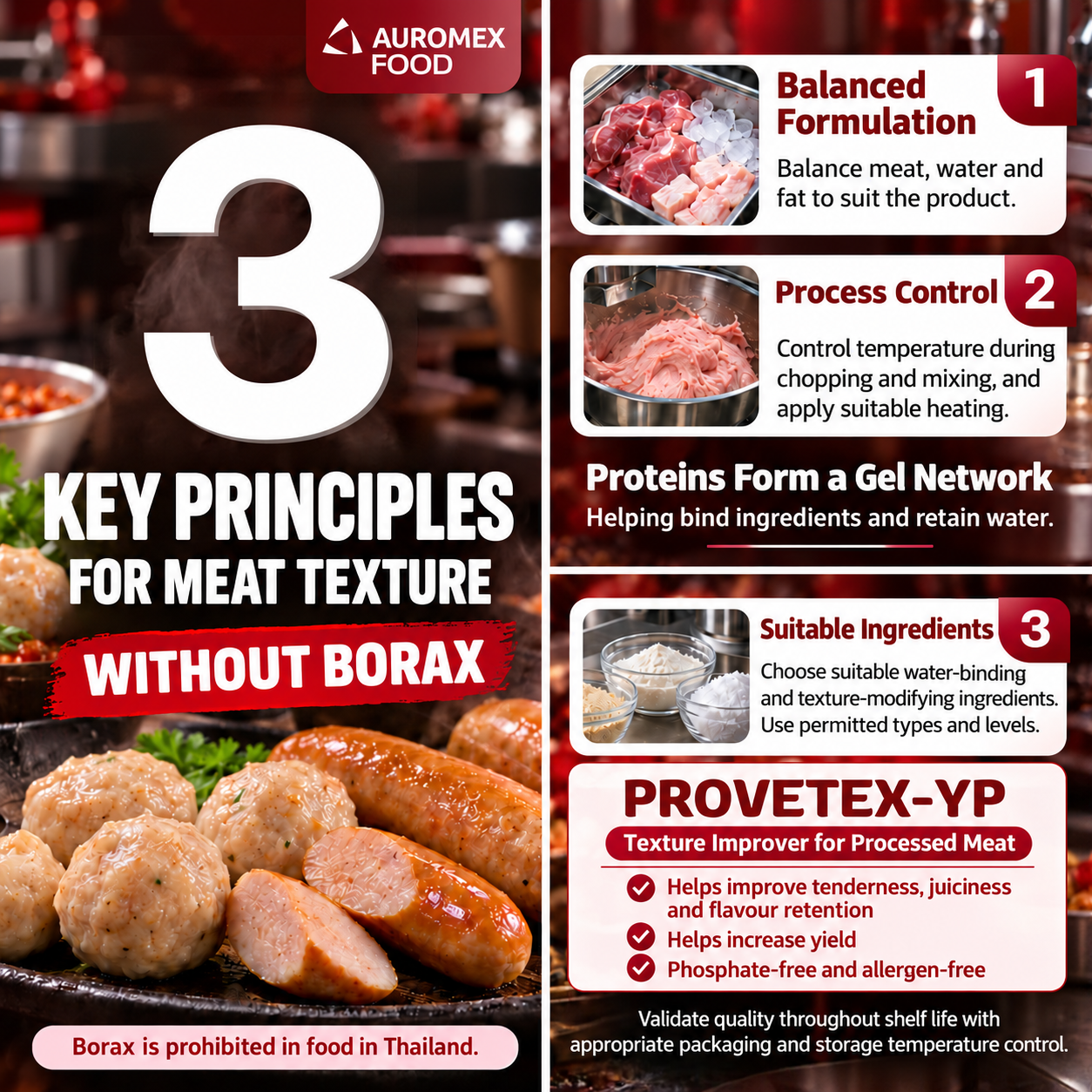
3 Key Factors in Processed Meat Texture Development: Introducing PROVETEX-YP
Texture is one of the first qualities consumers notice when eating a meat product. From springy meatballs to tender marinated meat and juicy sausages, the desired eating experience depends on the product and its intended use.
For manufacturers, choosing a processed meat texture improver starts with a clear development objective. Is the priority tenderness, springiness, juiciness or production yield? Defining the target helps guide formulation trials and makes the results easier to evaluate.
How Do Meat Proteins Contribute to Texture?
Muscle proteins play an important role in the structure of comminuted meat products. Under suitable salt and heating conditions, they can form a gel network that helps bind ingredients and retain water. Research on pork myofibrillar proteins has demonstrated that salt concentration and temperature influence gel properties and water-holding capacity.
The practical objective is to develop a texture that suits the product. Meatballs, sausages and marinated meat may require different formulations and processing conditions.
- Balance the Formulation
Consider the proportions of meat, water and fat alongside the other ingredients in the recipe. Define the desired texture before making formulation changes.
Typical development targets include:
- Meatballs: firmness, cohesion and springiness.
- Sausages: a smooth bite and a juicy eating experience.
- Marinated meat: tenderness and juiciness after cooking.
Record ingredient proportions clearly and compare samples under consistent conditions. This helps the development team determine whether a formulation change is moving the product towards its target.
- Maintain Consistent Processing Conditions
Formulation trials should be supported by controlled processing. Differences between production runs can make it difficult to identify which changes are responsible for the results.
Useful variables to record include raw material temperature, ingredient addition order, mixing or chopping time, processing temperature and heating conditions.
When comparing formulations, use the same portion size, cooking method and evaluation conditions. Also define when texture will be assessed: immediately after production, following chilled storage or after reheating. The evaluation should reflect how the product will actually be handled and consumed.
- Select Ingredients That Match the Development Goal
Texture-modifying ingredients should be selected for a specific purpose, such as improving tenderness, juiciness or yield.
Review technical information, suitable applications, recommended usage and relevant requirements before starting trials. Evaluate performance in the actual formulation rather than assuming that one ingredient will behave identically across all processed meat products.
What Is PROVETEX-YP?
PROVETEX-YP is a texture modifier for processed meat products from Auromex Food. According to its product information, it helps improve tenderness and juiciness, retain flavour and increase yield.
Manufacturers evaluating PROVETEX-YP should compare its performance within their existing formulation and production process. Useful assessment criteria include:
- Tenderness and juiciness after cooking.
- Flavour and sensory acceptance.
- Product weight at a clearly defined production stage.
- Consistency between production batches.
For cooking trials, one useful measure is:
Cooking Yield (%) = Cooked Weight ÷ Uncooked Weight × 100
Use the same cooking and weighing conditions for every sample so that comparisons remain meaningful.
How Should Texture Be Evaluated During Storage?
An assessment made on the production day may not fully represent a product that will be stored, transported and reheated.
A practical evaluation plan should track texture, liquid loss and sensory acceptance at defined intervals using the intended packaging and storage temperature.
Texture testing contributes to quality assessment. Establishing shelf life also requires appropriate evaluation of food safety and other relevant quality attributes.
Frequently Asked Questions About Processed Meat Texture Improvement
Do springy meatballs require borax?
No. Springiness develops when meat proteins form a gel network through mixing with salt and heating under suitable conditions. This network helps bind ingredients and retain water, giving meatballs their cohesive, elastic texture. The key is to balance meat, water and fat while controlling processing temperatures. Borax is prohibited for use in food in Thailand.
What is the recommended dosage of PROVETEX-YP?
The appropriate dosage depends on the meat type, water and fat content, processing conditions and target texture. The product leaflet referenced in this article does not specify a dosage, so a numerical recommendation cannot be provided from that information alone.
Once a recommended usage range is available in the technical documentation, test low, medium and high levels within that range against a control formulation without PROVETEX-YP. Compare tenderness, juiciness, flavour and yield under identical conditions to identify the dosage that meets quality targets at an appropriate cost. Adding more does not necessarily produce better results.
Is PROVETEX-YP phosphate-free and allergen-free?
According to its product information, PROVETEX-YP is phosphate-free and allergen-free, making it an option for formulations targeting these characteristics.
However, other ingredients must also be assessed, including milk, eggs, soy and seasonings containing allergens, along with potential allergen cross-contact during production. Using PROVETEX-YP alone does not automatically make the finished product phosphate-free or allergen-free.
Does using a texture improver automatically extend shelf life?
No. Maintaining tenderness or juiciness addresses only part of product quality. A product that retains an acceptable texture may no longer be safe to eat.
Shelf-life testing should use the intended packaging and actual storage conditions. Assess texture, liquid separation, colour, odour and microbiological quality as appropriate for the product. Use these results to establish shelf life rather than extending the expiry date based on texture performance alone.
Develop the Right Texture for Your Product
If you are developing processed meat products and want to improve tenderness, juiciness or yield, contact Auromex Food to learn more about PROVETEX-YP and discuss a trial approach for your application.