What Is Kokumi? How Yeast Extract Helps Create Flavorful Foods With Less Salt
Reducing salt in a food formulation involves more than removing an ingredient. Salt contributes to the overall flavor experience, so a reduced-salt product may seem less rounded or satisfying even when its other ingredients remain the same.
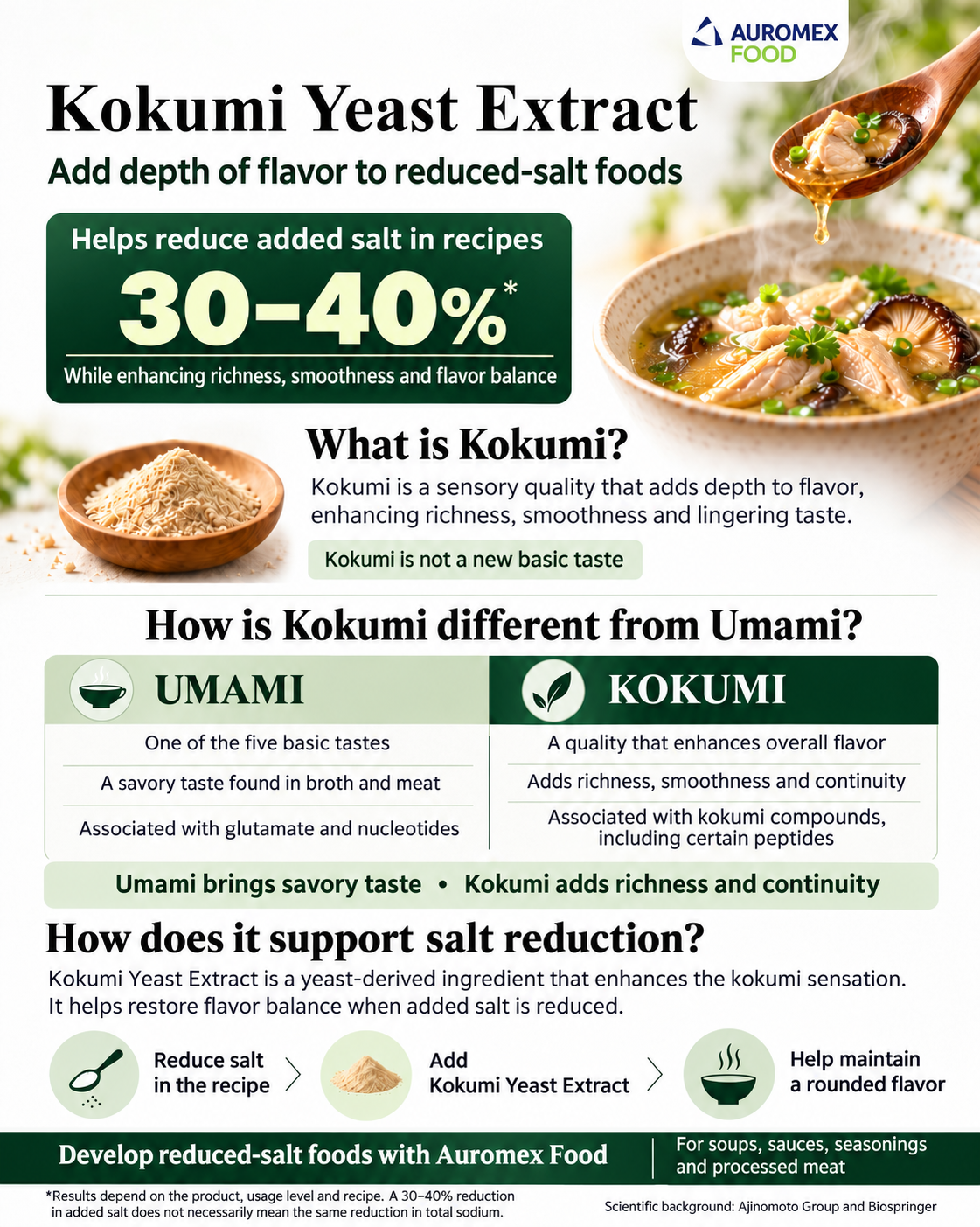
Kokumi yeast extract offers food developers a way to build flavor depth and continuity while adjusting the amount of salt added to a recipe.
What is kokumi?
Kokumi describes sensory qualities such as richness, depth, smoothness and a lingering sense of flavor. Think of a well-balanced broth that tastes rounded from the first sip and continues to feel satisfying after swallowing.
Kokumi compounds can enhance the perception of flavors already present in food. Kokumi is not classified as a new basic taste.
What is the difference between kokumi and umami?
Umami is one of the five basic tastes, alongside sweet, sour, salty and bitter. It is the savory taste associated with foods such as broth, meat and mushrooms.
Kokumi describes qualities that add richness, complexity and continuity to the overall flavor experience. Both can contribute to the same food: umami provides a savory taste, while kokumi can make that taste feel more rounded and sustained.
What is kokumi yeast extract?
Kokumi yeast extract is a yeast-derived ingredient selected for its ability to enhance kokumi-related sensory qualities. Certain compounds associated with kokumi, including glutathione and some peptides, occur in yeast. Their levels and effects vary between yeast extract products. Eat Well, Live Well.
In food formulation, an appropriate yeast extract can help build richness and flavor continuity, particularly when a recipe is being reformulated with less added salt.
How can kokumi yeast extract support salt reduction?
When salt is reduced, the overall flavor profile can lose some of its intensity and balance. Kokumi yeast extract helps address that sensory gap by adding depth and roundness. This gives product developers another tool for creating appealing reduced-salt foods. It is best evaluated as part of the whole formulation, rather than as a one-for-one replacement for salt.
Auromex Food offers kokumi yeast extract that can help reduce added salt in a formulation by 30–40%*, depending on the product, usage level and recipe. Sensory evaluation and testing in the finished product are essential to determine the appropriate formulation.
Potential applications include soups, sauces, seasoning blends and meat products. The right approach depends on each product’s desired flavor and processing conditions.
Develop reduced-salt foods with Auromex Food
A successful salt-reduction project considers taste alongside the texture and overall quality of the finished food. Auromex Food can provide information on kokumi yeast extract and its application to help you identify an appropriate starting point for formulation trials.
Contact Auromex Food to discuss your product and explore how kokumi yeast extract could support your reduced-salt formulation.
The 30–40% figure refers to a reduction in salt added to the recipe under suitable formulation conditions. It does not necessarily represent an equivalent reduction in total sodium in the finished product.
Frequently asked questions about kokumi
- Is kokumi the sixth basic taste?
No. Kokumi describes sensory qualities that can enhance existing tastes, including richness and flavor continuity. It is not classified as a new basic taste. - Are kokumi and umami the same thing?
No. Umami is a basic savory taste. Kokumi contributes to the perceived depth, roundness and continuity of the overall flavor. - Can kokumi yeast extract replace all the salt in a recipe?
That depends on the formulation. Salt may contribute to qualities beyond flavor, so its reduction should be assessed in the finished product. - Does 30–40% less added salt mean 30–40% less total sodium?
Not necessarily. Other ingredients may also contribute sodium. Total sodium should be calculated or measured separately. - How should a manufacturer begin testing kokumi yeast extract?
Start with a control recipe. Test several salt-reduction and yeast-extract usage levels, then compare flavor, consumer acceptance and finished-product quality before selecting a final formula.